
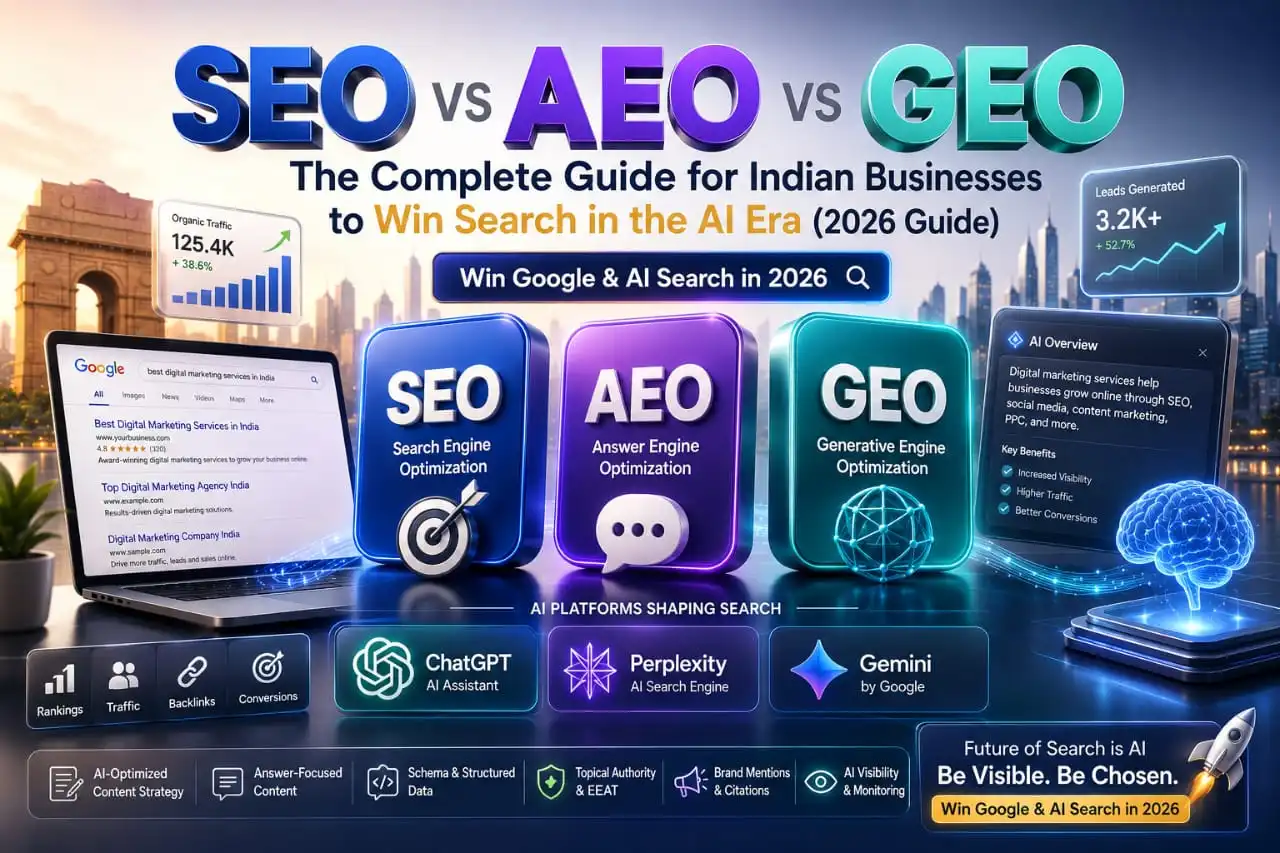
SEO
vs
AEO
vs
GEO
The Complete AI
Search Guide
for Indian Businesses
(2026)
Search has changed more in the last two years than it did in the previous decade.
For years, businesses focused on one goal: ranking on Google’s first page. If your website appeared in the top three results, you had a strong chance of attracting visitors, generating leads, and increasing sales. Today, that strategy alone is no longer enough.
The rise of AI-powered search experiences—including Google AI Overviews, ChatGPT, Gemini, Perplexity, and other generative search platforms—has fundamentally changed how people discover information. Instead of clicking through multiple websites, users increasingly receive direct, AI-generated answers that summarize information from trusted sources.
This shift presents both a challenge and an opportunity.
Businesses that continue relying only on traditional SEO may experience declining organic click-through rates for certain queries. At the same time, companies that adapt by optimizing for AI-driven search can expand their visibility across multiple discovery channels, reaching customers before competitors do.
At Vignesh Growth, we believe the future of search is not about choosing between AEO, GEO, or SEO. It is about understanding how these three strategies complement each other to create a complete search visibility ecosystem.
Think of modern search like owning commercial real estate in three different locations:
- SEO helps your business rank in traditional search engine results.
- AEO helps your content become the direct answer users see in search experiences.
- GEO helps AI models understand, trust, and recommend your brand when generating responses.
Businesses that invest in only one of these approaches risk missing valuable opportunities across today’s rapidly evolving search landscape.
Whether you run a startup, manage an enterprise organization, operate a real estate company, or lead a healthcare business, understanding the relationship between SEO, AEO, and GEO will be essential for maintaining online visibility over the next five years.
This guide explains how each strategy works, where they overlap, and how Indian businesses can build a future-ready search strategy that drives qualified traffic, strengthens brand authority, and generates sustainable business growth.
Why This Guide Matters in 2026?
Search is no longer limited to Google. Your potential customers are asking questions in:
To reach today’s customers effectively, businesses need a search strategy that performs across both traditional search engines and AI-powered platforms.
Who Should Read This Guide?
This guide is designed for:
- CEOs and business owners looking to generate sustainable online growth.
- Startup founders building long-term digital visibility.
- Marketing managers planning future-ready search strategies.
- Real estate companies competing in highly competitive local markets.
- Healthcare organizations aiming to build trust and authority online.
- Enterprises preparing for AI-driven customer acquisition.
Whether your goal is more qualified leads, stronger brand visibility, or higher organic revenue, this guide provides a practical framework for succeeding in both traditional and AI-powered search.
Understanding SEO, AEO & GEO
For years, SEO has helped businesses improve their Google rankings, drive organic traffic, and generate leads.
Today, search is changing. Users increasingly rely on AI platforms like Chat GPT, Google AI Overviews, Gemini, and Perplexity for instant answers instead of visiting multiple websites.
This evolution has introduced two new strategies:
- AEO (Answer Engine Optimization): Optimizing content to become the direct answer.
- GEO (Generative Engine Optimization): Optimizing your brand so AI platforms recognize and recommend it.
SEO isn’t being replaced—it’s evolving. Together, SEO, AEO, and GEO create a complete strategy for succeeding in the AI-powered search era.
The Evolution of Search
The way people discover information has changed significantly over the years.
| Era | User Behavior | Business Goal |
|---|---|---|
| Search Engine Era | Users typed keywords into Google and clicked website links. | Rank on Page 1 through strong SEO. |
| Mobile Search Era | Users searched on smartphones with local intent and voice search. | Improve mobile experience and Local SEO. |
| AI Search Era | Users ask conversational questions and receive AI-generated answers. | Build visibility through SEO, AEO, and GEO together. |
The goal has shifted from “ranking for keywords” to “being the most trusted source of information.”
What Is SEO?
SEO (Search Engine Optimization) is the process of improving your website so search engines can understand, index, and rank your pages for relevant search queries.
Its primary objective is to increase organic visibility, attract qualified visitors, and generate business growth without paying for every click.
A successful SEO strategy combines three core pillars:
1. Technical SEO
Technical SEO ensures that search engines can efficiently crawl, understand, and index your website.
It includes:
- Website speed optimization
- Core Web Vitals improvements
- Mobile responsiveness
- XML sitemaps
- Robots.txt optimization
- HTTPS security
- Structured data (Schema Markup)
- Crawl budget optimization
- Canonical tags
- Indexability improvements
Without a technically sound website, even exceptional content may struggle to rank.
2. On-Page SEO
On-page SEO focuses on optimizing individual pages so they align with user intent and search engine expectations.
Key elements include:
- Keyword research
- Search intent optimization
- SEO-friendly URLs
- Optimized headings (H1–H3)
- Internal linking
- Image optimization
- Meta titles and descriptions
- Content depth
- E-E-A-T signals
- Readability
Good on-page SEO helps search engines understand exactly what each page is about.
3. Off-Page SEO
Off-page SEO builds authority and trust beyond your website.
This includes:
- High-quality backlinks
- Brand mentions
- Digital PR
- Local citations
- Google Business Profile optimization
- Industry directories
- Reviews and reputation management
Search engines view these signals as indicators of credibility.
Business Example: SEO
Imagine someone searches:
“Best SEO agency in Hyderabad”
Google evaluates hundreds of ranking signals before deciding which websites appear first.
Factors include:
- Website authority
- Relevant content
- User experience
- Page speed
- Backlink quality
- Local relevance
- Business reputation
The better your SEO, the higher your chances of attracting qualified traffic from traditional search results.
What Is AEO?
Answer Engine Optimization (AEO) is the practice of structuring and optimizing content so search engines and AI-powered answer engines can provide your information as a direct answer to user questions.
Instead of competing only for website clicks, AEO helps your business become the source behind the answer itself.
Examples include:
AEO focuses on delivering clear, concise, trustworthy, and well-structured answers.
How AEO Works
Imagine someone searches:
“What is the difference between SEO and AEO?”
Instead of displaying ten blue links, Google may generate an AI Overview summarizing the answer from multiple trusted websites.
If your content is:
- Well structured
- Factually accurate
- Supported by strong topical authority
- Easy for AI to understand
your website has a greater chance of contributing to that answer.
That’s the goal of AEO.
Key Components of AEO:
Successful Answer Engine Optimization typically includes:
Question-Based Headings
Create natural questions matching how users search on Google and AI search platforms.
FAQ Sections
Answer common questions clearly to improve visibility in AI-generated responses.
Schema Markup
Use structured data to help search engines and AI understand your content.
Concise Answers
Provide direct 40–80 word answers before expanding with detailed explanations.
Clear Content Hierarchy
Structure content using logical headings, tables, lists and summaries.
Entity-Based Optimization
Strengthen semantic relationships between brands, topics, people and concepts.
Strong E-E-A-T Signals
Demonstrate experience, expertise, authority and trust across your content.
Conversational Language
Write naturally so both users and AI assistants can easily understand your content.
Comprehensive Topic Coverage
Cover every important aspect with examples, visuals, FAQs and supporting content.
Think of AEO as writing for both humans and machines.
What Is GEO?
Generative Engine Optimization (GEO) is the process of improving your brand’s visibility within AI systems that generate responses instead of simply listing websites.
Unlike SEO, which optimizes for search rankings, GEO optimizes for AI understanding, entity recognition, authority, and trust.
The objective is simple:
When someone asks an AI platform for recommendations, your business should be one of the brands it confidently references.
Where GEO Matters?
Generative optimization influences visibility in platforms such as:
- ChatGPT
- Google Gemini
- Microsoft Copilot
- Perplexity AI
- Claude
- AI-powered enterprise assistants
These systems analyze information from multiple trusted sources to generate answers—not just rank web pages.
How GEO Works?
Suppose a business owner asks:
“Which digital marketing agencies in India specialize in AI SEO?”
An AI assistant evaluates:
- Brand authority
- Topical expertise
- Consistent online mentions
- Website quality
- Expert content
- Reviews
- Structured information
- Industry recognition
The brands with the strongest authority and the clearest digital footprint are more likely to be recommended.
This is where GEO becomes essential.
Key Components of GEO:
An effective GEO strategy includes:
Unlike traditional SEO, GEO is about ensuring AI systems understand who you are, what you do, and why your brand can be trusted.
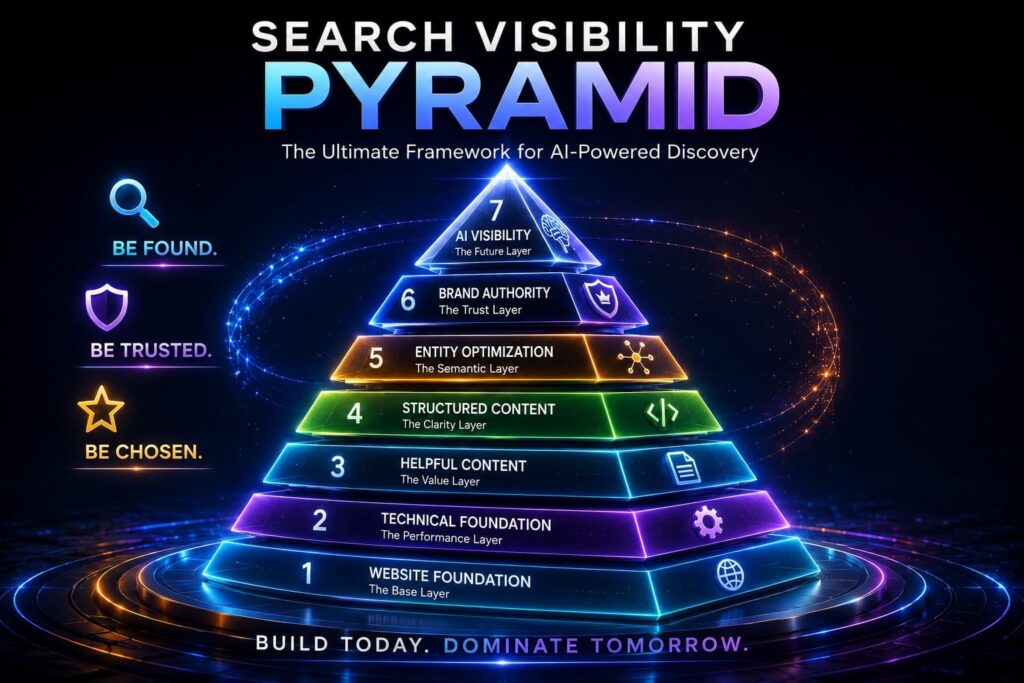
Search Visibility Pyramid
Build authority. Own search. Lead the future.
AEO vs GEO vs SEO – What's the Difference?
One of the biggest misconceptions in digital marketing today is that AEO and GEO are replacing SEO.
They’re not.
Instead, they solve different problems within the same customer journey.
Think of them as three layers of a modern search strategy:
- SEO helps people find your website.
- AEO helps your content answer users’ questions directly.
- GEO helps AI platforms recognize and recommend your brand.
Businesses that understand how these strategies work together are better positioned to capture visibility across traditional search engines and AI-powered platforms.
Quick Comparison: SEO vs AEO vs GEO
| Factor | SEO | AEO | GEO |
|---|---|---|---|
| Primary Goal | Rank higher in search engines | Become the direct answer | Become the AI-recommended brand |
| Focus | Organic search visibility | Answer engines & AI summaries | Generative AI platforms |
| Platforms | Google, Bing | Google AI Overviews, Featured Snippets, Voice Search | ChatGPT, Gemini, Perplexity, Microsoft Copilot |
| Optimization Target | Web pages | Questions & answers | Brand authority & entities |
| Success Metric | Rankings, Organic Traffic | Featured answers, AI citations | AI mentions, brand recommendations |
| Content Style | Comprehensive & keyword-focused | Clear, concise & structured | Authoritative, trustworthy & entity-rich |
Understanding the User Journey
Let’s look at how a modern customer searches for information.
Step 1: Discovery (SEO)
A business owner searches:
“Who Are the top 10 SEO freelancers in Hyderabad?”
Google returns a list of websites based on relevance, authority, and user experience.
Your SEO efforts determine whether your business appears on that list.
Step 2: Understanding (AEO)
The same user now asks:
“Who is the best AEO expert in hyderabad?“
Instead of clicking through multiple websites, they see a summarized AI-generated answer.
If your content is well-structured and authoritative, it may contribute to that response.
Step 3: Decision (GEO)
Finally, the user asks ChatGPT:
“Who is the best digital marketing freelancer in hyderabad?”
The AI evaluates trusted sources, brand authority, topical expertise, and online reputation before recommending businesses.
This is where GEO influences buying decisions.
Why SEO Alone Is No Longer Enough
Traditional SEO remains essential, but search behavior has changed.
Users increasingly:
- Ask conversational questions instead of typing short keywords.
- Expect instant answers without visiting multiple websites.
- Use AI assistants to compare products and services.
- Make purchasing decisions based on AI-generated recommendations.
If your strategy focuses only on ranking web pages, you’re missing opportunities across newer discovery channels.
Modern businesses need visibility wherever customers search—not just on Google.
Where Each Strategy Delivers the Greatest Value
| 🔎 SEO | 🤖 AEO | 🌐 GEO |
|---|---|---|
Delivers
Best for:
| Delivers
Best for:
| Delivers
Best for:
|
Don't Replace SEO—Expand It
Many businesses are reacting to AI by abandoning proven SEO practices.That’s a mistake.
At Vignesh Growth, we recommend an “Expand, Don’t Replace” strategy.
Phase 1: 📊 Build a Strong SEO Foundation
- Technical SEO
- Keyword strategy
- Content clusters
- Internal linking
- Page experience
- Authority building
Phase 2: 🧠 Optimize for AEO
- Answer user questions directly
- Add FAQ sections
- Use structured data
- Improve content formatting
- Target conversational queries
Phase 3: 🌐 Strengthen GEO
- Build topical authority
- Publish original insights
- Earn quality mentions
- Improve entity recognition
- Maintain brand consistency across the web
Why Businesses in India Need SEO, AEO & GEO
India’s digital landscape is evolving rapidly. Customers no longer rely only on Google Search—they also use AI-powered platforms like ChatGPT, Google AI Overviews, Gemini, and Perplexity to research products, compare services, and make buying decisions. This helps Agencies & freelancers to increase the SEO cost in Hyderabad for more then 32% compared to previous years.
For businesses, this means traditional SEO alone isn’t enough. To stay competitive, companies need a strategy that combines SEO, AEO, and GEO. Together, these approaches help businesses get discovered, answer customer questions, and build authority across both search engines and AI platforms.
🏢 Startups
Startups often have limited marketing budgets, making organic visibility essential.
- SEO attracts long-term organic traffic.
- AEO answers common customer questions and builds credibility.
- GEO helps AI platforms recognize and recommend your brand.
Business Benefit: Lower customer acquisition costs and sustainable lead generation.
🏛️ Enterprise Business
Large organizations manage multiple products, services, and locations, making consistency a challenge.
An integrated strategy helps enterprises:
- Improve technical SEO across large websites.
- Increase visibility in AI-generated answers.
- Strengthen brand authority across digital channels.
Business Benefit: Better market visibility, stronger brand trust, and scalable growth.
🏬 Local Business
Whether you’re selling products or software, customers compare options before making a purchase.
- SEO drives qualified traffic.
- AEO helps answer product-related questions.
- GEO strengthens brand authority across AI platforms.
Business Benefit: Higher conversions and improved brand recognition.
The Business Impact of SEO, AEO & GEO
Investing in SEO, AEO, and GEO isn’t just about improving search visibility—it’s about creating measurable business outcomes. A well-executed strategy helps businesses attract qualified prospects, build trust, reduce marketing costs, and generate sustainable revenue.
Here’s how these three strategies contribute to business growth.
📈 Increased Organic Traffic
SEO remains the primary driver of organic website traffic. By optimizing your website for relevant keywords and search intent, you attract users actively looking for your products or services.
AEO and GEO expand this visibility by helping your content appear in AI-generated answers and recommendations, allowing your brand to reach potential customers across multiple search platforms.
Business Impact: More visibility, more qualified visitors, and reduced dependence on paid advertising.
🎯 Higher Quality Leads
Not all traffic converts into customers. Businesses need visitors with strong purchase intent.
SEO attracts users searching for specific solutions, while AEO answers their questions during the research phase. GEO builds trust by positioning your brand as an authoritative recommendation in AI-powered search.
💰 Revenue Growth
Organic search is one of the highest ROI marketing channels because it continues generating traffic long after content is published.
As your visibility improves across Google Search, AI Overviews, and generative AI platforms, your opportunities to attract new customers increase without proportionally increasing advertising costs.
Business Impact: Sustainable revenue growth and improved marketing efficiency.
🏆 Stronger Brand Authority
Customers trust businesses that consistently appear across multiple digital touchpoints.
Ranking on Google, appearing in AI-generated answers, and being recommended by AI platforms reinforces your expertise and builds credibility over time.
This increased visibility positions your brand as a trusted industry leader.
Business Impact: Greater brand recognition and stronger competitive positioning.
👥 Improved Customer Trust
Modern customers research extensively before making a purchase.
By publishing accurate, helpful, and expert-led content, businesses can answer customer questions before the first conversation begins.
This educational approach reduces uncertainty and builds trust throughout the buying journey.
Business Impact: Higher customer confidence and stronger long-term relationships.
📊 Better Return on Investment (ROI)
Unlike paid advertising, where visibility stops when your budget ends, SEO, AEO, and GEO create long-term digital assets.
Optimized content continues attracting visitors, generating leads, and supporting business growth over time.
While results require patience, the long-term return often exceeds many short-term marketing channels.
How to Build a Future-Ready SEO, AEO & GEO Strategy ?
SEO, AEO, and GEO shouldn’t be treated as separate strategies.The most successful businesses integrate them into a single approach that improves visibility across search engines and AI platforms.
At Vignesh Growth, we follow a simple framework:
Optimize your website. Answer customer questions. Build brand authority.
1. 🏛️ Build a Strong SEO Foundation
Before optimizing for AI, ensure your website is technically sound.
Focus on:
- Fast loading speed
- Mobile-friendly design
- Clear site structure
- HTTPS security
- Proper indexing
- Optimized service pages
2. 🌐 Build Topical Authority
Instead of targeting individual keywords, create comprehensive content around your expertise.
For example, an SEO content hub could include:
- Technical SEO
- Local SEO
- AI SEO
- SEO Audits
- Keyword Research
This helps search engines and AI platforms recognize your authority.
3. 💬 Create Answer-Focused Content
Write content that solves customer questions using:
- Clear headings
- Direct answers
- Examples
- Tables
- FAQs
Helpful content performs better in both Google Search and AI-generated responses.
4. 🛡️ Strengthen Brand Authority
Build trust by:
- Publishing original insights
- Showcasing case studies
- Earning quality backlinks
- Highlighting expert authors
- Maintaining consistent business information
These signals improve your visibility in AI-powered search.
5 . 📊 Measure Business Results
Before optimizing for AI, ensure your website is technically sound.
Focus on:
- Fast loading speed
- Mobile-friendly design
- Clear site structure
- HTTPS security
- Proper indexing
- Optimized service pages
Common Mistakes Businesses Make with SEO, AEO & GEO !
As AI-powered search continues to evolve, many businesses are rushing to adopt new strategies. Unfortunately, this often leads to costly mistakes that limit visibility, reduce trust, and waste valuable marketing resources.
Understanding these pitfalls can help you build a stronger, future-ready search strategy.
1. Treating SEO, AEO, and GEO as Separate Strategies
One of the biggest mistakes is assuming that SEO, AEO, and GEO compete with each other.
In reality, they work best together.
Businesses that invest only in traditional SEO may miss opportunities in AI-powered search, while those focusing only on AI optimization often overlook the technical foundation required for long-term success.
2. Publishing Content Only for Search Engines
Many websites still create content around keywords instead of customer needs.
Modern search engines and AI platforms prioritize content that genuinely helps users solve problems.
Ask yourself:
- Does this article answer a real business question?
- Does it provide practical value?
- Would someone bookmark or share this content?
If the answer is no, it’s time to rethink the content strategy.
3. Ignoring Technical SEO
Even the best content won’t perform well if search engines struggle to crawl or understand your website.
Common technical issues include:
- Slow page speed
- Broken internal links
- Poor mobile experience
- Duplicate content
- Missing metadata
A strong technical foundation improves both user experience and search visibility.
4. Relying Entirely on AI-Generated Content
AI tools can speed up content creation, but publishing AI-generated text without human review often results in generic, repetitive, or inaccurate information.
Businesses should use AI as an assistant—not as a replacement for expertise.
The best-performing content combines AI efficiency with human experience, original insights, and industry knowledge.
5. Forgetting About Brand Authority
Many companies focus on ranking individual pages but neglect their overall brand presence.
AI platforms are more likely to reference businesses that demonstrate expertise consistently through:
- Original research
- Expert opinions
- Customer success stories
- Industry recognition
- Consistent online branding
Building authority takes time, but it creates long-term competitive advantages.
6. Measuring the Wrong Metrics
A #1 ranking doesn’t automatically translate into business growth.
Instead of focusing only on keyword positions, monitor metrics that reflect real business performance:
- Qualified leads
- Organic conversions
- Revenue from organic traffic
- Customer acquisition cost (CAC)
- Brand search growth
- Engagement metrics
These indicators provide a more accurate picture of marketing success.
How to Avoid These Mistakes
A successful search strategy should be built around three principles:
- Optimize your website for search engines.
- Educate your audience with valuable, trustworthy content.
- Build long-term authority that both users and AI platforms can trust.
When these principles work together, your business is better equipped to adapt as search technology continues to evolve.
The Future of Search (2026 & Beyond)
Search is no longer just about finding websites—it’s about finding the best answers. As AI becomes deeply integrated into search experiences, businesses must adapt their digital strategies to remain visible and competitive.
While no one can predict the future with complete certainty, one thing is clear: businesses that embrace AI alongside traditional SEO will have a significant advantage.
🤖 Google AI Mode & AI Overviews
Google’s AI prioritizes businesses with valuable content, making SEO more important than ever for earning visibility, trust, and qualified traffic.
To improve your chances of being featured:
- Create comprehensive, trustworthy content.
- Demonstrate expertise and experience.
- Structure information with clear headings and FAQs.
- Keep content updated with the latest insights.
🚀 AI Search Platforms Will Continue to Grow
Platforms like ChatGPT, Gemini, Microsoft Copilot, and Perplexity are changing how people research products, compare services, and make buying decisions.
Instead of browsing multiple websites, users increasingly expect AI to recommend the most relevant and trustworthy sources.
Businesses that establish strong topical authority today will be better positioned as these platforms continue to evolve.
🎙️ Voice & Conversational Search
People are no longer searching with just a few keywords. They ask questions naturally, and optimizing for those conversations helps your business appear in AI-powered search results.
🧠 The Rise of Agentic AI
The next evolution of AI is expected to go beyond answering questions.
AI agents will increasingly help users:
- Research products
- Compare service providers
- Schedule appointments
- Recommend businesses
- Complete online tasks
This means your digital presence must be trustworthy enough for AI systems to confidently recommend your business—not just display your website.
How Businesses Can Prepare ?
To stay ahead, businesses should focus on five priorities:
- Build a technically strong website.
- Publish original, experience-driven content.
- Strengthen brand authority across digital platforms.
- Answer customer questions with clarity and accuracy.
- Continuously monitor and adapt to changes in search behavior.
Businesses that invest in these areas today will be better prepared for tomorrow’s search landscape.
Final Thoughts
Traditional SEO will continue to drive organic visibility. AEO will help businesses become the preferred answer, while GEO will strengthen brand recognition across AI-powered platforms.
Build a Search Strategy for the AI Era
Search is evolving faster than ever, but the objective remains the same: helping the right customers find the right business at the right time.
Throughout this guide, we’ve explored how:
- SEO improves your visibility in traditional search engines.
- AEO increases your chances of becoming the answer users see.
- GEO helps AI platforms recognize and recommend your brand.
Rather than choosing one strategy over another, successful businesses will integrate all three into a single, long-term growth plan.
If your goal is to increase organic traffic, generate qualified leads, and future-proof your online presence, now is the time to evolve your search strategy.
Ready to Future-Proof Your Business?
Whether you’re a startup, enterprise, real estate company, or healthcare provider, an integrated SEO strategy can help you stay ahead of competitors in both traditional and AI-powered search.
At Vignesh Growth, we help businesses build scalable search strategies that combine SEO, AEO, and GEO to drive measurable business growth.
Frequently Asked Questions (FAQs)
1. What is the difference between SEO, AEO, and GEO?
SEO helps your website rank in traditional search engine results. AEO focuses on optimizing content to appear as direct answers in AI-powered search experiences, while GEO improves your brand’s visibility and authority within generative AI platforms like ChatGPT and Gemini. Together, they create a comprehensive search strategy.
2. Is SEO still relevant in 2026?
Absolutely. SEO remains the foundation of digital visibility. While AI is changing how people search, search engines still rely on high-quality, technically optimized websites to deliver reliable results.
3. Can AEO replace SEO?
No. AEO complements SEO rather than replacing it. Without a strong SEO foundation, your content is less likely to be discovered, trusted, or referenced by AI-powered answer engines.
4. How does Google AI Overviews affect SEO?
Google AI Overviews summarize information from trusted sources, giving users quick answers. Businesses that publish accurate, well-structured, and authoritative content have a better chance of contributing to these AI-generated summaries.
5. How can businesses optimize for AI search?
Focus on creating helpful content, answering customer questions, improving technical SEO, using structured data, building topical authority, and maintaining a consistent online brand presence.
6. Is technical SEO important for AI search?
Yes. Technical SEO ensures your website is crawlable, fast, secure, and easy for both search engines and AI systems to understand.
7. Does AI-generated content help SEO?
AI can improve content creation efficiency, but human expertise is essential. Content should always be reviewed, enhanced with original insights, and fact-checked before publication.
8. What is the future of SEO?
SEO is evolving rather than disappearing. Businesses that combine SEO with AEO and GEO will be better positioned to succeed as AI-powered search continues to grow.
9. Which industries benefit the most from SEO, AEO, and GEO?
Almost every industry can benefit, but the greatest impact is often seen in real estate, healthcare, SaaS, e-commerce, professional services, education, and enterprise businesses where customers conduct extensive online research before making decisions.
10. Should small businesses focus on SEO or AEO first?
Small businesses should start with a strong SEO foundation to build visibility and organic traffic. Once that foundation is established, adding AEO and GEO strategies can expand their reach across AI-powered search platforms.
The Vignesh Growth Perspective
At Vignesh Growth, we believe successful search strategies aren't built around algorithms—they're built around people. When businesses focus on solving customer problems with trustworthy, well-structured content, better search visibility naturally follows across both traditional and AI-powered platforms.